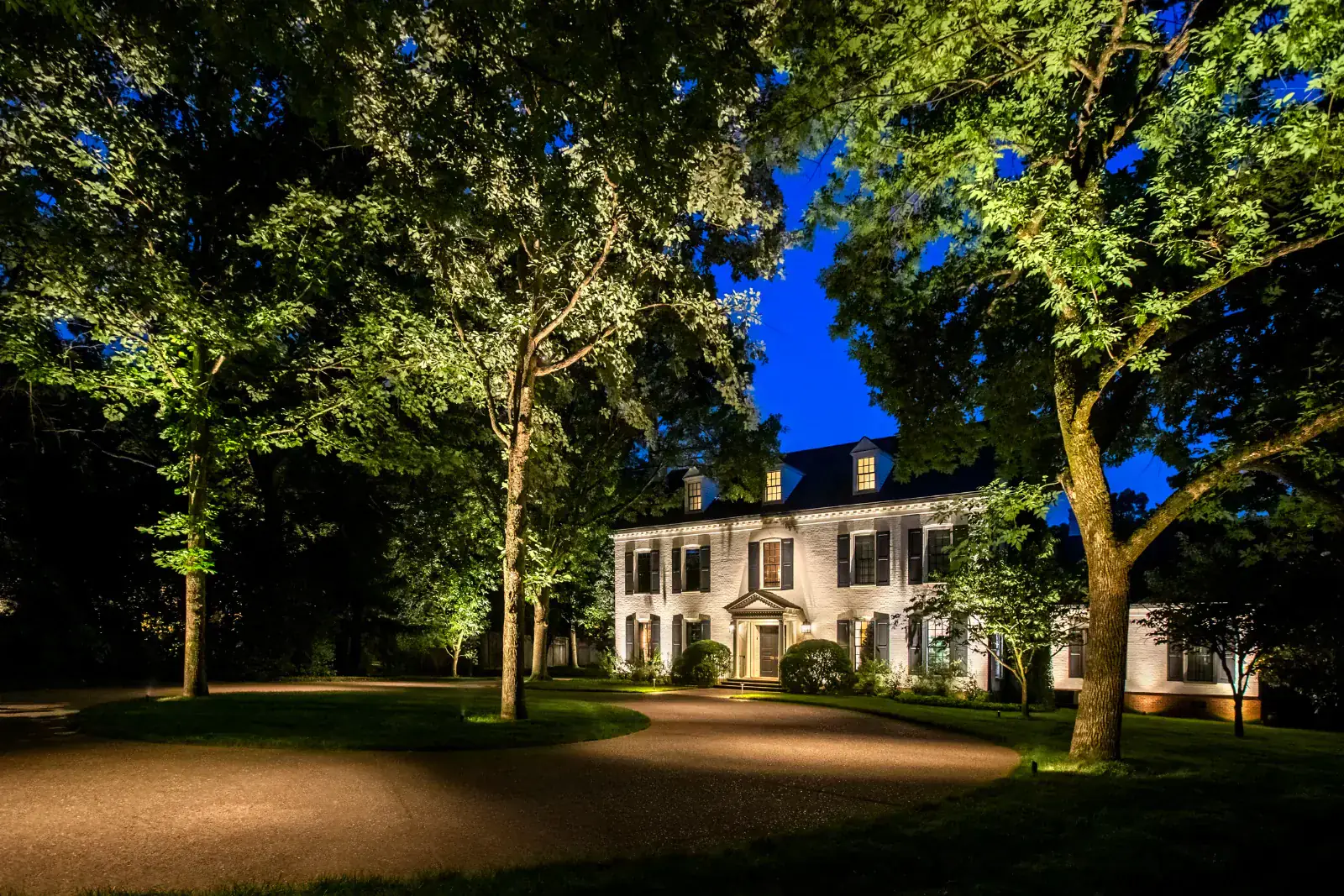
A wooded setting can make the garden feel enclosed after sunset. For your Chesterfield property, moonlighting may reveal a usable space beneath the canopy while leaving much of the woodland dark. The design begins with the area below the branches, not the number of trees available.
Moonlighting uses an elevated downlight to reveal selected space beneath it, with branches sometimes adding patterned shadows. NightOak can use it to define the near edge of a landscape without illuminating the entire woods.
We assess the light path through the canopy, tree condition, mounting suitability and access before selecting equipment. Cable routes, the low-voltage supply and controls are planned for that position. Once installed, we aim the fixture after dark and check the useful coverage, avoiding an attempt to solve blocked light simply by increasing brightness.
Usually the first decision is what you want to see or use in front of it. A patio edge, a short route or a clearing may deserve attention while the deeper woods remain a backdrop. Lighting every trunk can distract from that purpose and change the quiet character of the view.
Look at the actual path from a possible fixture location to the ground. Branches and foliage may create texture or block most of the useful light. Raising brightness alone may intensify bright patches without resolving the coverage. Another position or technique may be more appropriate.
It may help reveal that transition where a suitable source can reach it. We consider the lawn from the house and from the outdoor areas you use. A broad wash is not always necessary; a limited illuminated area can establish depth without exposing every part of the boundary.
Only if the actual coverage suits the route through the seasons. Decorative shadows are not the same as useful illumination at a change in level. We assess the path and steps separately, and may combine overhead light with discreet lower fixtures where the canopy leaves important gaps.
More light may reach the ground and a previously concealed source may become visible. The strongest seasonal contrast can matter as much as the summer effect. Planning should account for both conditions, with a review after substantial changes to the canopy.
Possibly, if it has a clear role in the wider scene. An uplight reveals the tree, while a downlight serves the area below. We compare their brightness, direction and color so the combined treatment does not simply make the same spot the brightest part of the property.
The proposed mounting position, tree condition, cable route and future access all need assessment. Ground cover and landscape maintenance also affect where equipment can run. Tree-care advice may be needed if condition or structural suitability is uncertain; mature size alone is not approval to mount a fixture.
Already have lights that are not working? Start with outdoor lighting repair.
Choose a question to prepare a note for your design conversation.
Usually the first decision is what you want to see or use in front of it. A patio edge, a short route or a clearing may deserve attention while the deeper woods remain a backdrop. Lighting every trunk can distract from that purpose and change the quiet character of the view.
A conversation starter, not a site assessment, lighting simulation or estimate. Nothing is sent automatically.