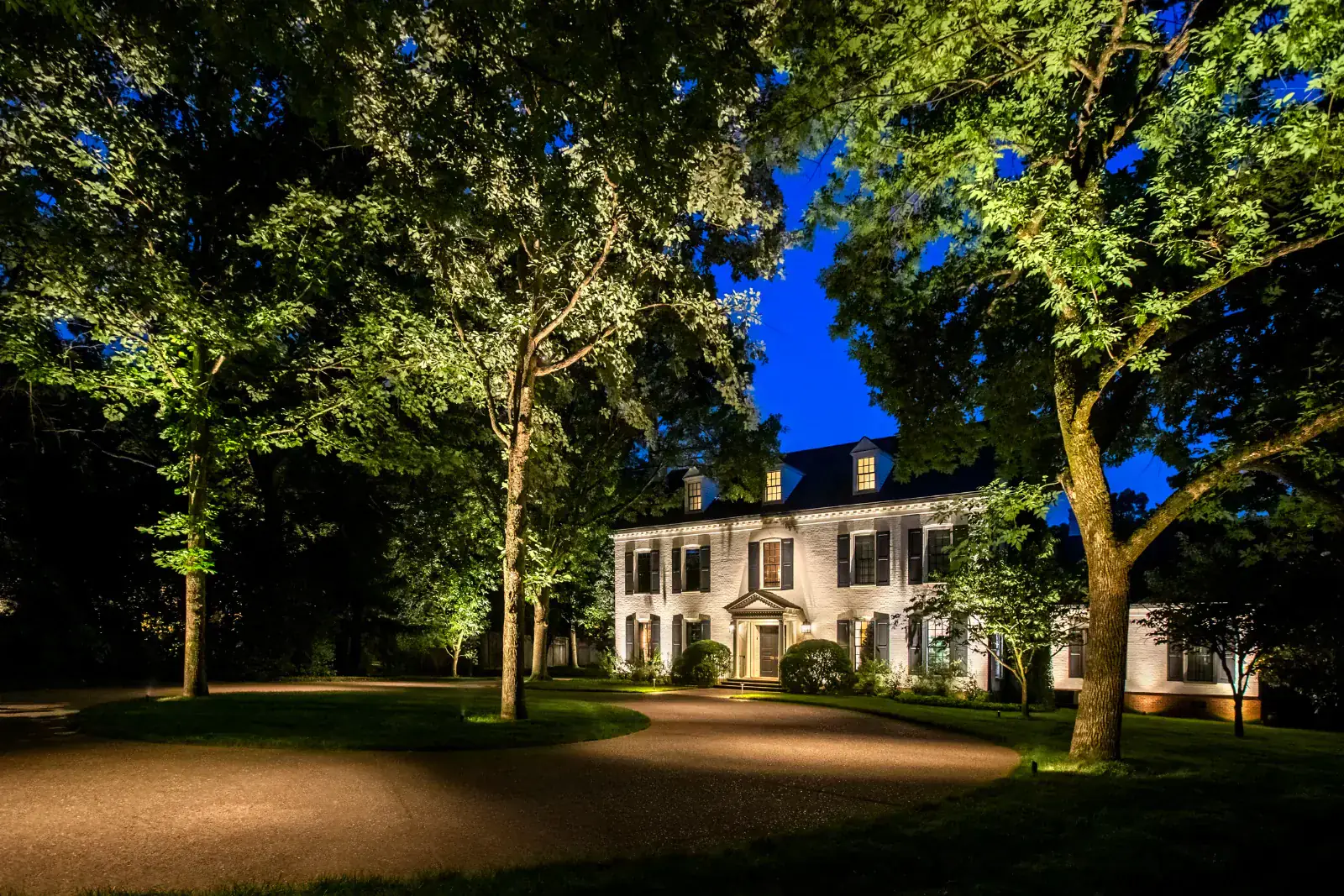
An open view does not need to become a uniformly lit landscape. For a Powhatan property with outdoor areas separated by lawn or planting, moonlighting can be considered at selected destinations, with the darker space between them treated as part of the design.
Moonlighting creates a selected pool of downward light beneath a suitable elevated source. NightOak can use it for a particular outdoor destination while keeping the surrounding landscape quieter.
We assess the destination first, then the available mounting position, access and cable distance. Low-voltage capacity and controls are planned around the agreed scope rather than the maximum distance a light might reach. After installation, nighttime aiming checks the foreground and wider view so the new light does not overwhelm the darker surroundings.
Their use matters more than visual symmetry. A seat near the house and a separate garden destination may need different levels of emphasis or operating hours. We identify what you want to see and where you actually spend time before choosing the areas to illuminate.
Distance and mounting height affect the beam, but a broad reach is not automatically a good result. A source aimed across a large area may become visible or create uneven brightness. A closer suitable position or a different technique may serve the destination more comfortably.
Keep the foreground from becoming unnecessarily bright and choose a limited number of useful accents. Strong light close to the house can dominate the scene. The relationship between nearby surfaces and the more distant view matters as much as the output of any individual fixture.
Yes. Select the outdoor area you will enjoy first and discuss later destinations at the planning stage. Cable routes, system capacity and control groups may affect those later phases. The initial proposal should be clear about what is installed now and what, if anything, is reserved for expansion.
Longer cable routes need an electrical design that accounts for the load, conductor size, voltage and equipment arrangement. Access and existing services also affect the route. The right solution should be established from the property rather than assumed from the distance alone.
Compatible zones and controls may allow separate operation. Decide which spaces need evening light and which are used only occasionally. The equipment must support the intended behavior, and any change to an existing system needs a compatibility review before those features are promised.
Start with what each location can support and how it will be maintained. A distant tree may offer attractive shadows but difficult access; a shielded lower fixture may better serve a particular route or feature. The whole-property plan can use both without repeating one treatment across every area.
Already have lights that are not working? Start with outdoor lighting repair.
Tree and facade accents give the home a clear setting after dark. When overhead lighting is added, review those existing layers together so the patio or garden receives gentle light without competing with every nearby feature.
Choose a question to prepare a note for your design conversation.
Their use matters more than visual symmetry. A seat near the house and a separate garden destination may need different levels of emphasis or operating hours. We identify what you want to see and where you actually spend time before choosing the areas to illuminate.
A conversation starter, not a site assessment, lighting simulation or estimate. Nothing is sent automatically.