
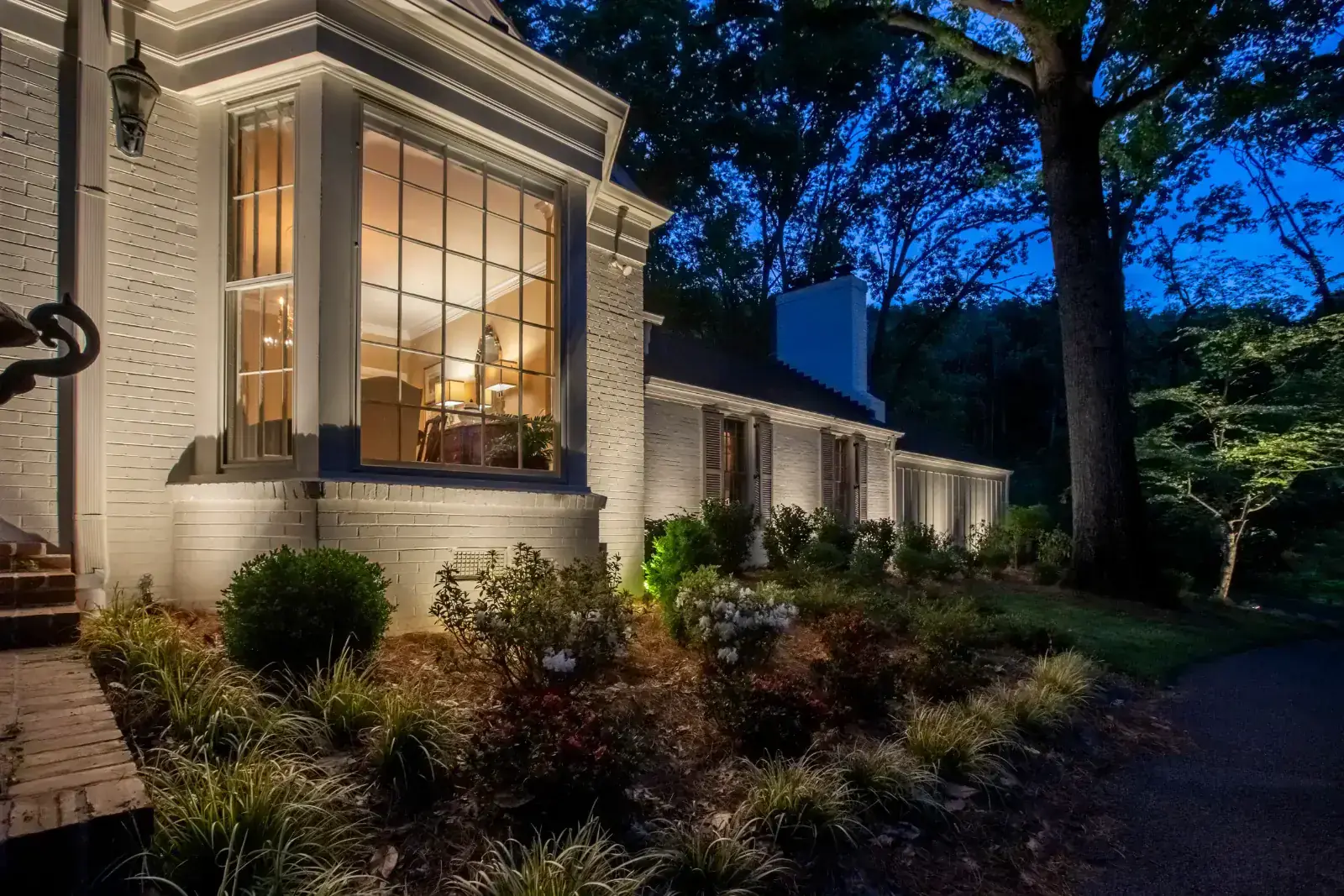
How should uplighting relate to arriving home?
The view changes as you turn into a driveway, park and walk toward the door. A tree accent that looks comfortable from the street may expose its light source from a parking space. We evaluate those everyday viewpoints before finalizing fixture positions.
We consider both longer driveways and compact walks, including turns, guest parking and nearby trees. The uplighting should support that arrival sequence rather than become a distraction within it.
What can tree accents do on a wooded homesite?
Selected trees can give a wooded view definition and connect it to the house. We consider trunk and canopy structure, the distance from the viewer and the surrounding plants before choosing beam spreads.
Established neighborhoods near the Glen Allen Cultural Arts Center and wooded homesites farther west offer different planning contexts. Neither calls for a standard fixture count; the actual site and its main views guide the design.
How are window and neighbor sightlines handled?
We look at where people see the light from, not only what the fixture illuminates. Windows, seating, parking areas and neighboring homes can all affect the location, shielding and aiming of an uplight.
Grade changes deserve particular care because a fixture may sit closer to eye level along part of the approach. Nighttime adjustments help test the effect from the real viewing positions.
Will uplighting make the walk visible too?
An uplight is intended for a vertical feature such as a tree or facade. Its spill should not be relied upon to illuminate a walking route or step consistently. Those surfaces may need dedicated pathway or step lighting.
We install the chosen low-voltage fixtures with planned cable routes, protected connections and transformer capacity suited to the load. We coordinate those layers so arrival feels coherent. The house and trees provide visual structure, while the walking-surface lighting has a separate practical role.