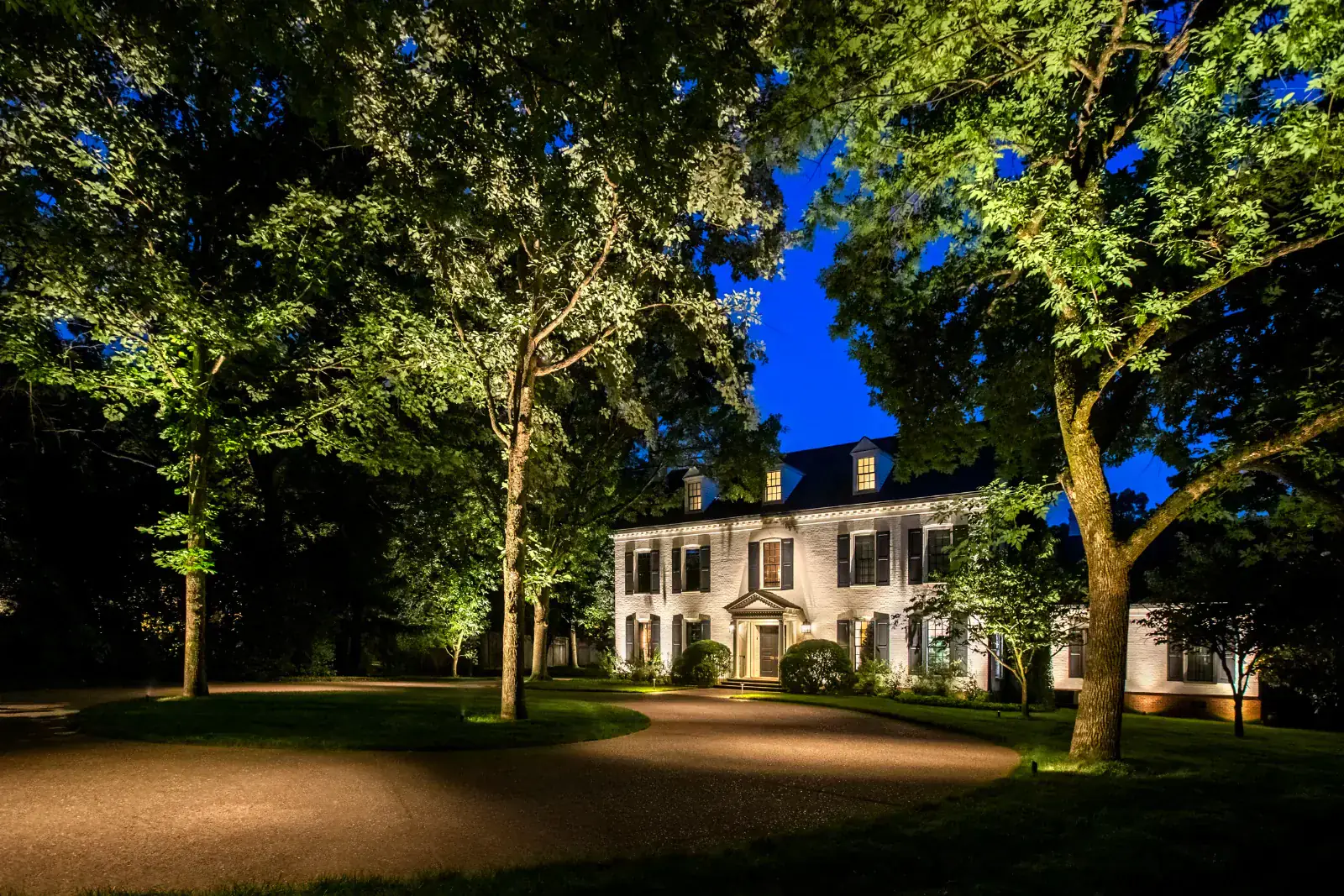
Light from above can bring a path, lawn or seating area into view while leaving space for shadow. For your Manakin-Sabot property, the first question is whether the trees and the space beneath them make moonlighting a sensible choice.
Moonlighting creates a downward light effect from a suitable tree or structure, often with a softer pattern than ground-level uplighting. NightOak starts with the area you want to enjoy beneath the canopy.
We assess tree condition, branching, mounting suitability, cable routing and access for future service before committing to the overhead approach. Where tree health is uncertain, qualified tree-care input may be needed. We then install suitable low-voltage equipment and review the beam and shielding after dark from the intended ground-level views.
Height alone is not enough. The proposed mounting position, branch structure, tree condition, cable route and access for installation and future care all matter. A suitable-looking canopy may still place the light in the wrong position for the ground below. If tree health or structural condition is uncertain, qualified tree-care input may be needed.
Begin on the ground: the path people follow, the edge of a sitting area or a lawn seen from the house. Then assess whether a practical overhead position can reach it. Moonlighting should not be chosen only because the tree is tall or because a downlight is easy to hide in one branch.
Leaves and branches can create an attractive pattern, but too much obstruction can leave the intended area poorly illuminated. Placement and aiming need to account for the light path, not just the canopy’s appearance. Another location or a different lighting technique may be the better solution.
Yes. Leaf growth, leaf fall, wind and pruning alter the pattern and the amount of light reaching the ground. The design should allow for that variation. A check after substantial canopy changes helps identify whether aiming or another adjustment is appropriate.
Consider the source from the chairs, the route through the garden and nearby upstairs windows. A position concealed from one viewpoint can be exposed from another. Shielding, aiming and output need to work with those sightlines rather than relying on leaves to hide the fixture all year.
Elevated fixtures need a practical maintenance plan. Equipment access, the cable path and the mounting arrangement should allow for tree growth and future checks. A location that is difficult to reach can change the work involved in routine care, so it belongs in the initial discussion rather than becoming a surprise later.
A suitable structure may support downlighting, though the effect will differ from light passing through a leafy canopy. Shielded path lights, step lighting or selected ground-level accents may also address the same outdoor space. We recommend the method that fits the property rather than forcing moonlighting into an unsuitable setting.
Already have lights that are not working? Start with outdoor lighting repair.
Choose a priority to bring into your design conversation.
Check whether a practical elevated position can illuminate the route through the canopy. A tall tree alone does not establish useful coverage.
A conversation starter, not a site assessment, lighting simulation or estimate. Nothing is sent automatically.