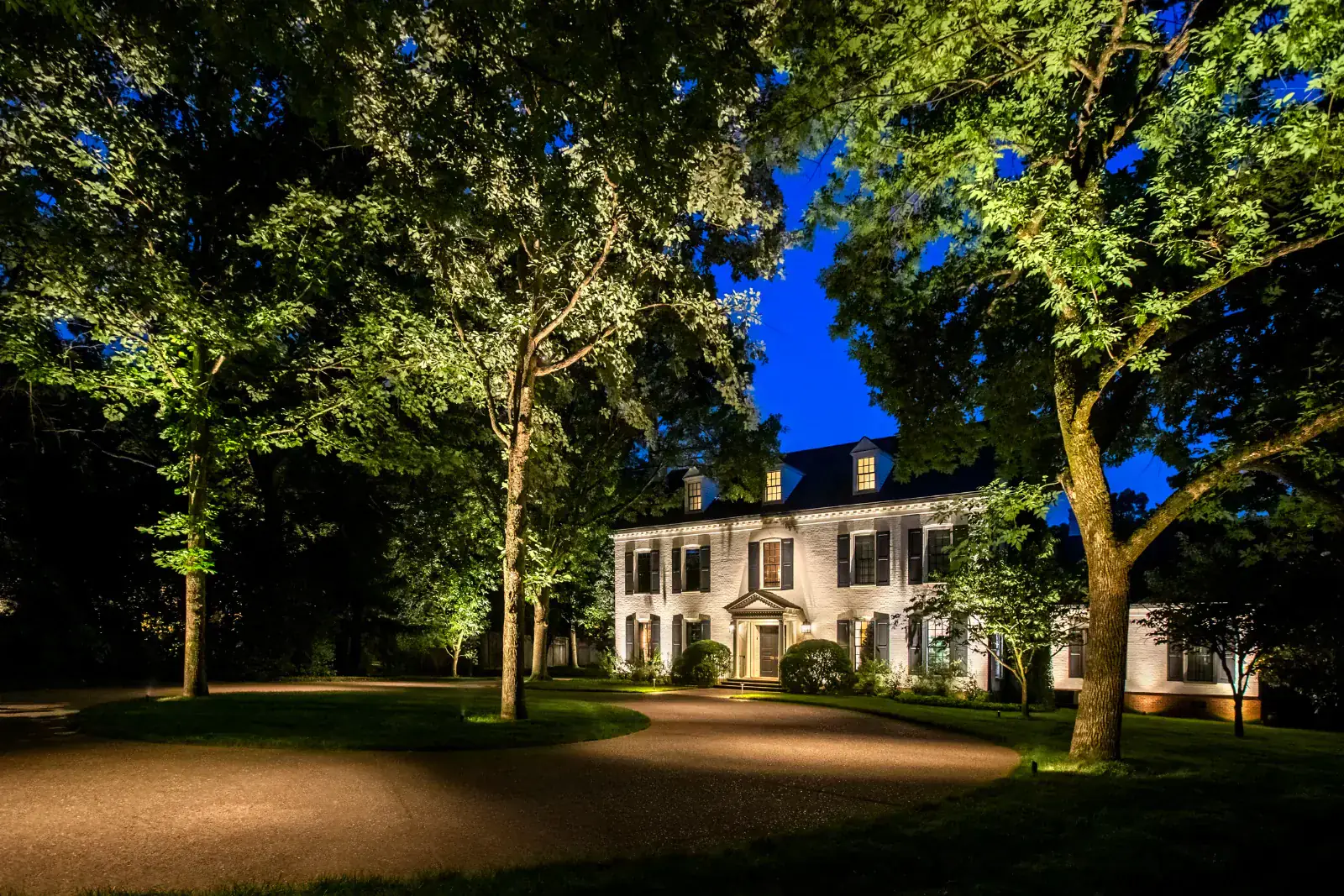
The lighting plan begins before you reach the front door. For a Goochland property with a long approach or a wooded entrance, consider the journey in stages: the turn from the road, changes in direction, the parking area and the walk inside.
Driveway and entrance lighting helps define the places where an arrival changes direction, reaches parking or continues on foot. NightOak can create a clear sequence without assuming a long drive needs continuous decorative lighting.
We review the drive in both directions and agree on the points that need useful light. Cable distances, equipment loads, crossings and controls guide the low-voltage layout. We protect copper-crimp connections in direct-burial gel-filled tubes, then aim and assess the installed fixtures after dark from driver and pedestrian sightlines.
Not every approach calls for an uninterrupted row of fixtures. Start with the places where people need to understand the route, such as a bend, a junction or the transition into parking. The surface, surrounding darkness and actual use of the drive determine where useful illumination belongs.
Selected trees can frame an entrance and give the approach depth. Their light may not reach the driving surface, however. We assess landscape accents and route lighting separately, then balance them together. A bright canopy is not a substitute for considering what a driver or pedestrian needs to see.
Review the approach in both directions, including the view from the road and from a vehicle leaving the property. Shielding, output and fixture position need to work together. A light that looks comfortable from the front steps may still be visible at a lower driving sightline.
Discuss cable crossings and accessible routes before new hardscape closes them off. Existing sleeves or conduit may help, but their position and condition need to be verified. Gate equipment, walls, drainage and other services can affect the layout, so the lighting plan should be coordinated with the actual work rather than assume a later route will be easy.
They can. The load, cable length, conductor size and transformer arrangement affect voltage at the fixtures. The plan needs to account for those conditions before installation. Simply adding a larger transformer does not resolve every voltage-drop problem or make unsuitable existing wiring adequate.
The transition from parked vehicle to front walk deserves its own review. People may move through a turning area, cross a change in level or approach steps from an unfamiliar direction. We plan that connection alongside the entrance and landscape rather than ending the design at the parking space.
Downlighting may be an option where the mounting location, light path and future service access are suitable. A tree beside the drive does not guarantee good coverage below it. Ground-level and overhead approaches can also be combined when the property calls for both.
Already have lights that are not working? Start with outdoor lighting repair.
Choose a priority to bring into your design conversation.
Review the arrival and departure sightlines. The location and aiming of a light should support the turn without creating a bright point at driver eye level.
A conversation starter, not a site assessment, lighting simulation or estimate. Nothing is sent automatically.