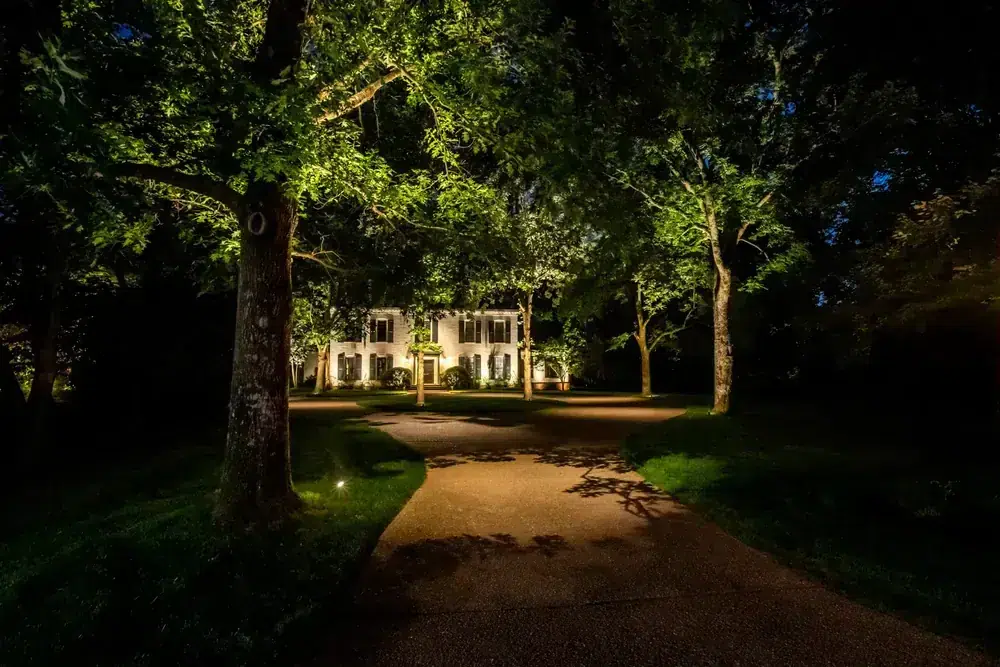
From the turn into your drive to the walk to your door, thoughtful lighting helps the arrival feel connected. NightOak designs driveway and entrance lighting around your property, its landscape and the way you come home.
The design should help you understand the route: where to turn, where the driveway changes direction, where to park and how to reach the entrance. Carefully directed light on these transitions can work with nearby trees and architecture, creating a welcoming arrival without treating the entire drive as one brightly lit surface.
Choose the part of the journey you want to improve. Use the result as a starting point for your design conversation.
Consider the driveway opening, nearby landscape and the view from the street. The design should define the entrance while keeping exposed light sources out of approaching drivers' sightlines.
A design conversation starter, not a visibility assessment, installation plan or price estimate. Nothing is submitted automatically.
Start with the decisions people make as they arrive: turning, following a curve, parking and finding the door. We review the driveway from driving and walking positions, then consider planting, nearby windows and the connection to pathway and architectural lighting.
The layout responds to changes in direction, width and surrounding landscape. Accent light on selected trees can help frame a route, but it does not automatically provide useful light on the driveway surface. We consider both, along with cable routes and the electrical demands of a longer installation.
Glare is a design consideration from the start. Shielding, mounting height, aiming and brightness should work together for approaching vehicles and people on foot. The aim is to reveal the arrival area while keeping exposed lamps out of normal sightlines and limiting spill toward the street and neighboring properties.
Where suitable trees or structures provide appropriate mounting locations, downlighting can be part of the design. Its suitability depends on the mounting position, the light's path to the ground and access for service. Ground-level and overhead lighting may be combined where the property calls for both.
Possibly. Transformer capacity, wiring condition, voltage drop, controls and the proposed cable route all need review. We also look at how the new lighting will balance with the rest of the property. An existing-system assessment comes before recommending additional fixtures.
Driveway length, the number of arrival areas, fixture choices, access, hardscape crossings and existing equipment all affect the work. We review these conditions before defining the scope. Your estimate should reflect the actual route and design rather than a standard number of lights per foot.
Cleaning lenses, checking aiming and correcting shifted fixtures help maintain the result. Vehicle movement, landscape work and plant growth can change conditions around the lights. Controls should also reflect the hours you use the arrival area. If lights are flickering or out, arrange a service assessment.
Already have lights that are not working? Start with lighting repair.
We review the property, the views you enjoy and how you use the space after dark.
Fixture placement, wiring, controls and the setting are considered together in the design and installation.
Nighttime fine-tuning helps balance aiming and brightness. Service and maintenance options support ongoing care.
Explore planning questions for your community. This page covers our Richmond-area approach.
Explore all service areas →